You wake up in the ashes of a dead world
that stretches in every direction. With no
memory of who you are and no hope for
survival, you are drawn to the last standing
structure: a lone tower. Here, you must
navigate the labyrinthian tower reliquary,
and choose difficult decisions to survive
and discover your true purpose within the
remnants of this forgotten realm. As you
ascend the tower, you learn of its terrible
secrets, ancient magic, dangerous rituals,
haunting echoes of past, demons forgotten
and uncaring eldritch machines. Will you
survive?
Overview
Challenge
Holding
complete responsibility
over the completion and delivery of the
Narrative.
Opportunity
Having
complete creative control
over the narrative.
Background
For this project, I was commissioned by
Nedi Games
to create a
Visual Novelcentered around themes of fantasy and
intrigue. The client aimed to develop a rich
world and interconnected stories to be
presented as playable narratives on their
mobile gaming platform.
The initial deliverable was a prototype built
in
Twine. Later, I was also tasked with refactoring
the game dialogue and logic to accommodate new
requirements and to adapt the content for use
in
Articy Draft 3.
Tools
Twine Articy draft 3 Obsidian
Miro Google Docs
Responsibilities
Pitched, Envisioned and wrote multiple
different worlds and story Ideas for the
client. Created the main world,
history, and lore for the game. Created
the characters and an outline for the
story. Crafted an expansive branching
path narrative incorporating the themes of
the story. Used twine and Articy draft
to create one among many prototypes. Refactored
the story and ported the prototypes for
different platforms.
Pitched, Envisioned and wrote multiple
different worlds and story Ideas for the
client. Created the main world,
history, and lore for the game. Created
the characters and an outline for the
story. Crafted an expansive branching
path narrative incorporating the themes of
the story. Used twine and Articy draft
to create one among many prototypes. Refactored
the story and ported the prototypes for
different platforms.
I began by finding the
right themes; Since, I was given complete control of the
creative direction, I chose to draw
inspiration
from the artist works of artists like
Zdzisław Beksiński
and
Picasso, whose works had deeply captivated me at the
time.
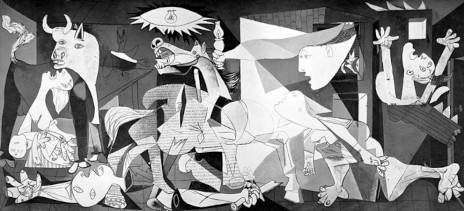
Picasso's Guernica
Guernica
uses a stark monochrome palette and a
fragmented Cubist style.
Its
eerie depictions
of humans, animals, and architecture draw the
viewer’s focus to the
devastating bombings
of guernica embodying the panic, anxiety, and
suffering
of those lost in the Guernica bombings.
This combined with my research about
Environmental Suffering helped me conjure up
the theme of ‘The Ripples of Trauma‘ which heavily influenced the
direction of the
story
in this project.
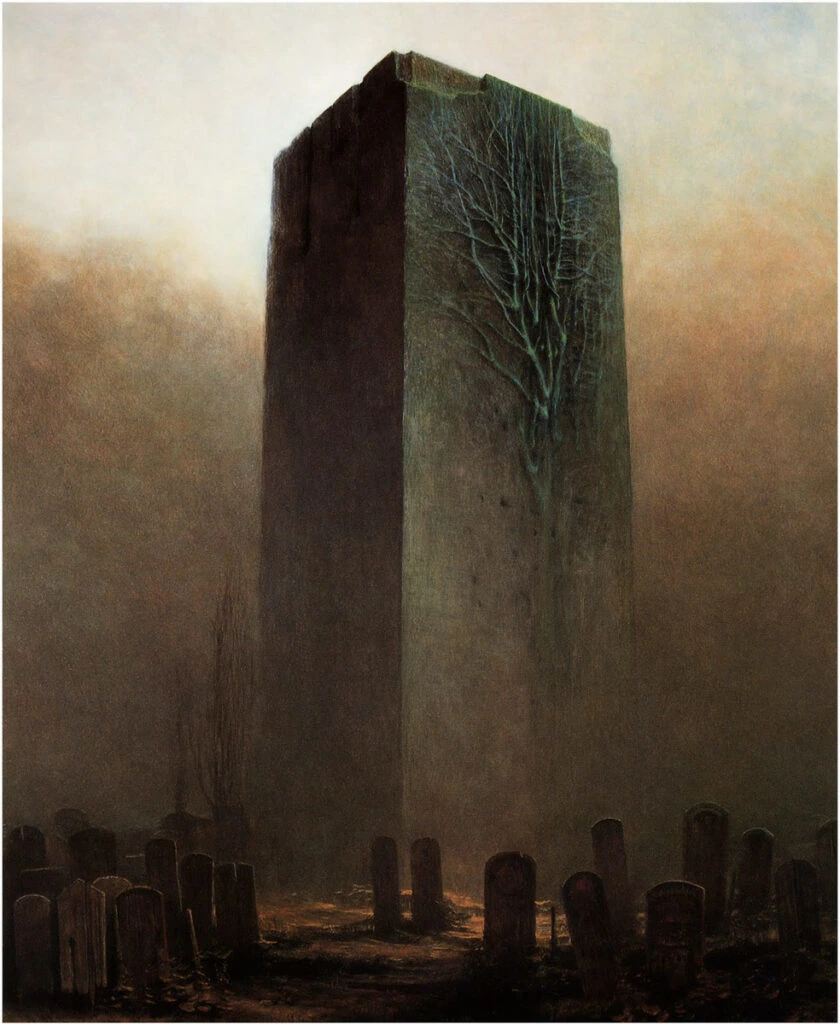
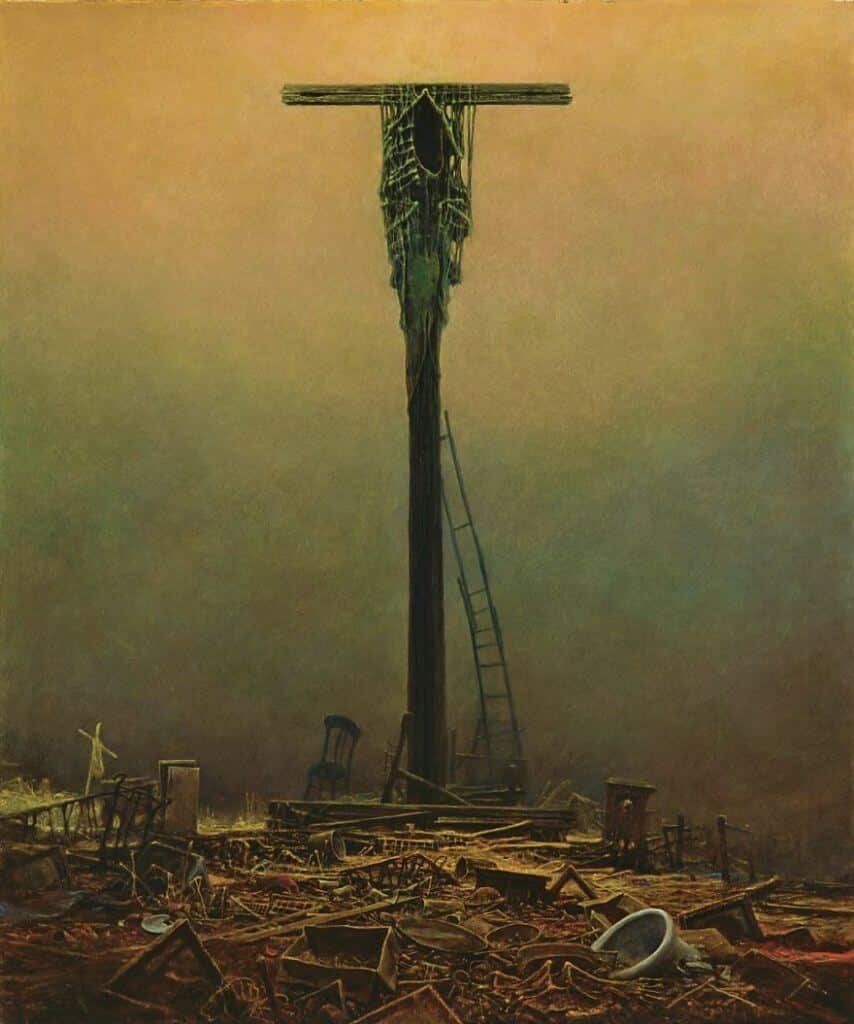
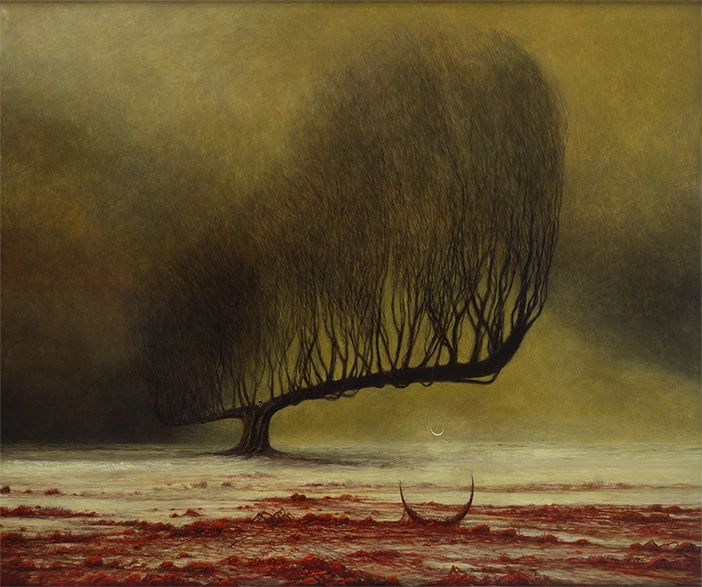
Zdzisław's fantastic realism period
His paintings of this era had always evoked a
deep sense of
dread
and
fatalism
in me.
Zdzisław makes use of
haunting landscapes decorated with an
otherworldly grunge
that could not have been reminiscent of
anything other than the representation of
human suffering and evil that we humans are
capable of inflicting.
I tried to replicate some of this kind of
existentialism and dread through the
world building
for this project.
Facism
There was a
common theme
in both: a desire to emulate the
anguish of the victims of Fascism. Guernica was a starkly political piece that
had condemned the bombings of Guernica, during
the Spanish Civil War by the Fascist air forces
of Germany and Italy.
Similarly, the “fantastic period”
can be interpreted as a representation of the
horrors of the holocaust. And though Zdzisław rejected those
claims, his life under German occupation of
Poland had an undeniable influence on his art.
Other Inspirations
Harlan Ellison’s I Have No Mouth, and I
Must Scream Beserk by Kentaro Miura Nausicaä
of the Valley of the Wind The Hotel by
Boichi
02. Developing Themes
Ethos - The Ripples of Trauma
For the main theme, I chose to explore the
intricacy of the
cyclical and rippling nature of trauma
that is prevalent within societies.
In my reading into how trauma originates, I
learnt that environmental circumstances are
often the initial trigger for the beginning of
any such cycle.
Environmental sufferingsuch as war, disasters, oppression, fascism,
and or other intense periods of distress can
drastically change one’s behavior and
force them to develop
maladaptive coping mechanisms. This in turn can cause them to inflict the
same suffering onto others – children,
communities, and, over time, these patterns can
even become embedded in the very fabric of
logic that shapes entire
civilizations.
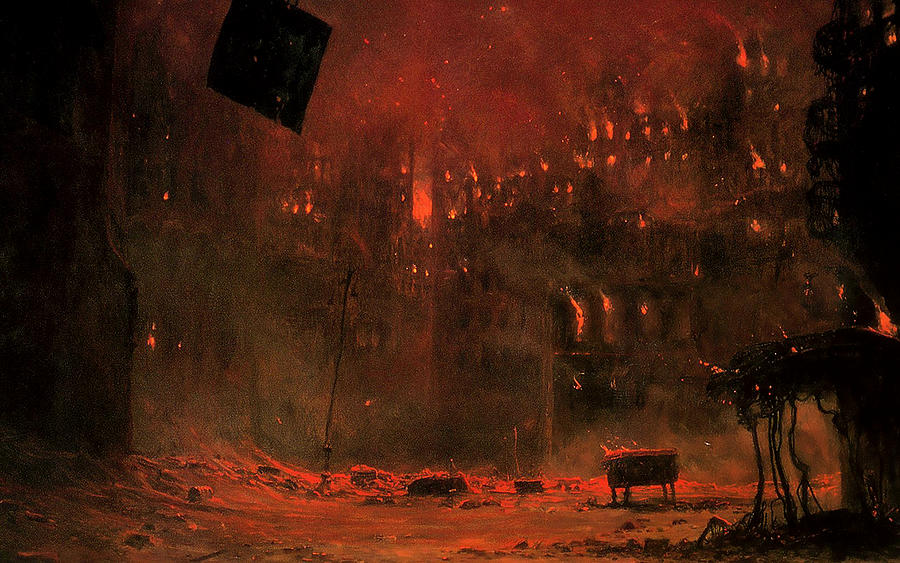
Untitled - City On Fire is a painting by
Zdzislaw Beksinski
Like stones dropped in a pond, this trauma
ripples outward, and then inevitably inward,
sustaining
a never-ending cycle
across generations, until those effected can
recognize it and break free.
This theme strongly embodies the struggle of the
protagonist of The Guernica Engine, who, in the
story,
seeks meaning to the centuries of proxied
suffering
they have endured – as a consequence of a
vain misguided attempt of another to right their
own wrongs. This journey
parallels the divisive ways
in which people grapple with inherited trauma.
Core Themes:
– Trauma and how to deal
with it. – Fascism as an ideology
deeply rooted in hate. – Violence
as the primordial form of force and
language. – Parent-child
relationship – Facism
Sub-themes:
– Patriarchy in its inherently unstable
form of governance. – Mistakes are
to be learned from or to be repeated. –
Control and Manipulation by authority. –
Colonial Mindset – Environmental
Degradation – Nature vs Nurture
03. World Building
The World of The Guernica Engine
I crafted a
post-catastrophe world
set a millennium after the
civilization’s collapse. In this
nightmarescape, scattered survivors forage the ruins for
the last the of Arkana Contracts (Powerful
artifacts created by the
Allfathers, a group of
technomancers
whose reckless experiments scarred
civilizations and began the end that led to
the catastrophe).
The Tower
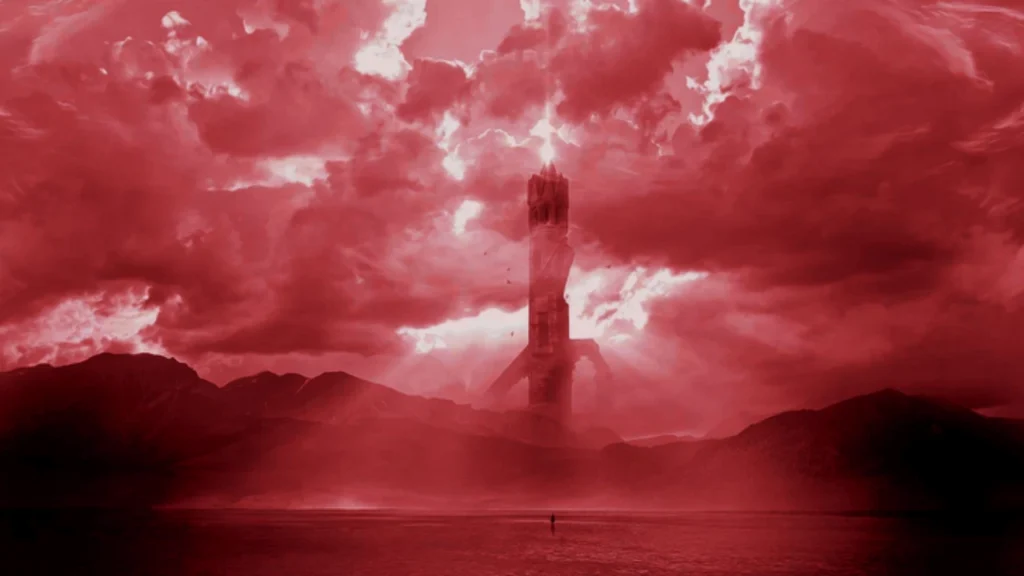
In the midst of this austerity, stands
The Tower, a labyrinthine reliquary-library housing
ancient knowledge, memories, and the
mysterious
Guernica Engine
– An enigmatic instrument that was once
purposed to manipulate and understand the
Arkanic essence
ever-prevalent in the world – which now
sits fused in the tower’s edifice,
powering the tower with a wild Arkana that
leaks through its halls and blurs the line
between memory and reality.
The Guernica Engine
The setting is meant to evoke
a persistent, inescapable exhaustive
dread. It embodies
the final stage of the trauma
cycle, where the environment itself becomes a
victim, scarred by the inherited suffering
passed down from those long dead. With the
birth of the protagonist
into this world, a new opportunity chances to
confront the legacy and perhaps, finally, to
end the cycle.
There’s more to the World Lore than
what is presented here.
If you’d like to explore additional
work I’ve done for this project, please
feel free to
reach out.
04. Story
Short Description
1. In a devastated world shaped by long forgotten
experiments,
the Player Character, known only as
the Vessel, emerges from a tar pit with no memory of
their origin. Drawn to a towering structure that
looms over the wasteland, they enter
the Tower
in search of answers.
2.Inside, they meet
Dorian, a sentient mural who insists that
the answers the protagonist seeks lie at the
summit in the enigmatic instrument known as
the Guernica Engine
and urges the Vessel to ascend.
3.
Along the way, an unstable
Arkana surgedrags the Vessel into a simulated memory of the
pre-catastrophe world where they encounter
Fay, a mysterious girl.
Unavoidable circumstances pull both of them into
reality, and from there, all three of them
continue upward through shifting magical
chambers.
4.As the climb progresses, the begin to learn the
truth.
Garland,
a long deceased caretaker of the Tower,
reveals the horrifying reality:
The Vessel is the latest incarnation in the long
series of artificial test subjects created as a
part of an experiment by the
Compiler Mage,
(one of the last surviving mages responsible
for the catastrophe). In believing that he could create a form of
life superior to what came before, the mage
repeatedly subjected each “Vessel”
to brutal trials. One of them eventually
rebelled and killed the Mage. But instead of
chosing to end the experiment, the rebelling
subject took control of the Tower and continued
the experiments. That was Dorian.
Garland, the tower's caretaker AI, set in motion
and orchestrated the birth of one final Vessel,
hoping to end this cycle of suffering, once and
for all.
5.At the top of the Tower, the Vessel reaches the
Guernica Engine, a godlike artifact that is the
the source of the Tower’s power and the
heart of the experiment. It offers the vessel a
series of
critical choices. These included - choice to whether to
destroy or to preserve the Tower, to grant or to deny life to Fay,
to resist or to continue the cycle of
experiments
, by erasing Dorian and
taking full control
of the tower and the experiment.
6.Depending upon
player choice, the story can end in multiple different ways.
(Covered under Gameplay)
I wanted to create a dynamic character arc for
the protagonist that would reflect the
complicated ways in which people learn to either
deal with their trauma or co-opt it.
For this, I wrote multiple differing arcs that
the player could pursue by making certain
choices throughout the game.
These choices are grouped into different
categories where each type thematically
represents a certain aspect of the struggle of
the Trauma, like –
Acceptance (Central Thread) -
Accepting the past and forgiving those who
hurt you.
Propagation (Secondary Thread) -
Learning to identify and control your harmful
behavior, and making an active effort to not
let those around you be affected by them.
Control (Tertiary Thread) -
Understanding the relation between oneself and
authorities.
The ARC,
The central thread of
the protagonist’s
arc is
acceptance
– coming to terms
with the difficult truth
of who they are and what
precedes them. (This includes
identifying and
confronting the
cycle of
trauma.)
Over the course of their
journey, the protagonist
uncovers the full extent
of their past and
gradually understands
how the world came to
its current desolate
state. When the
Guernica
Engine
finally reveals itself
and binds to the
protagonist, it presents
a critical list of
facilities and
choices:
Whether to hand
control of the Tower
over to Dorian or
assume control
themselves
Whether to erase
Dorian or let him live
Whether to destroy the
Tower or allow it to
remain
Thematically,
these
choices
respectively represent:
Accept: To accept the past
and acknowledge its
failures, or to deny it
and justify the
oppression as a
necessary evil
Forgive: To forgive those who
have caused pain, or to
choose not to
Forget: To forget the past
and start entirely anew,
or to remember it and
move forward with its
weight
Each decision represents
a key step in the
process of healing from
trauma.
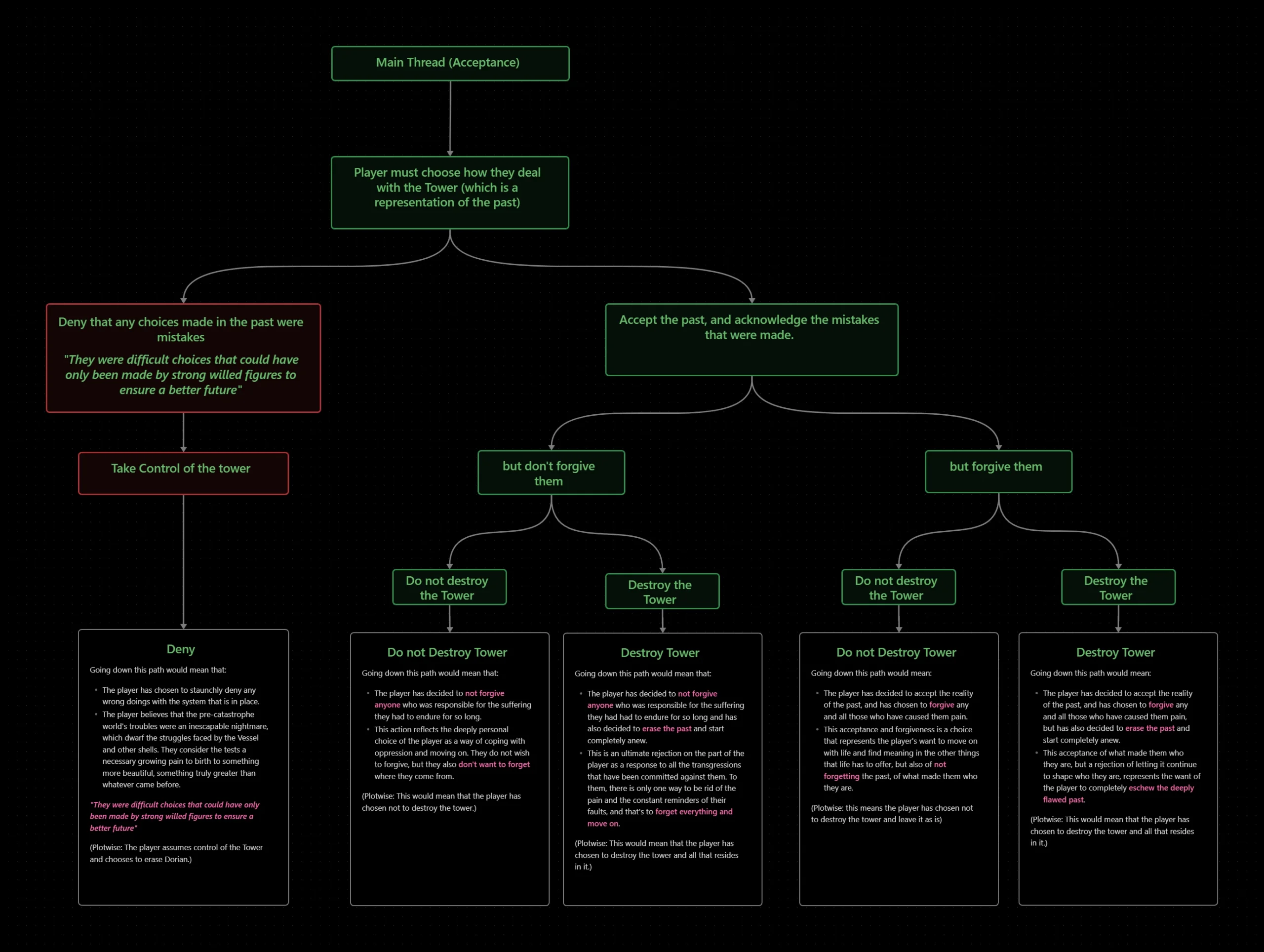
Main Thread (Acceptance)
Decision Tree
Mechanically,
these
choices
allow the player to
pursue distinct paths
toward catharsis, shaped
by what they’ve
learned from the
Tower’s reliquary,
its inhabitants, and
their own personal
reflections.
The decisions are
entirely player-driven,
to shore up the idea
that the journey towards
healing and
understanding trauma is
deeply personal and
non-linear.
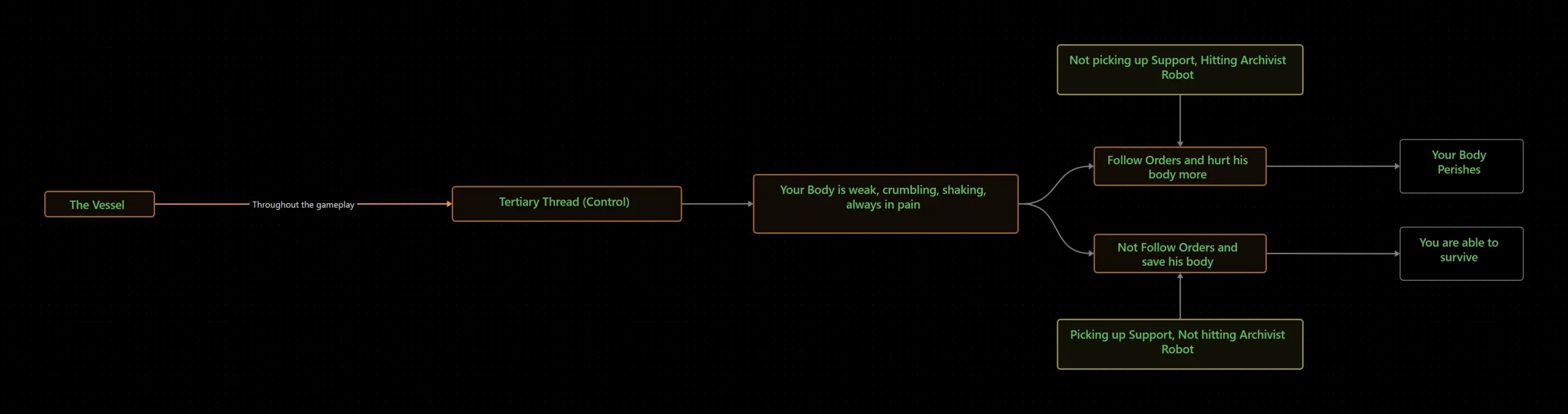
Tertiary Thread
(Control)
Thematically,
It represents the voice
everyone has in the back
of their mind,
continuously critiquing
and demeaning them.
This is the voice that
becomes a surrogate for
all the negative and
constant derogations
that are directed at
them by others, by
authority figures, even
when they are no longer
around.
They lose all shape and
form and become
mystified, lingering
whispers.
Mechanically,
The voice is there to
color any first
impressions of the
player and influence
their decision-making.
It has no direct effect
on the game, other than
softly trying to
influence the player
themself. However,
over the course of
the game, choosing to listen to
the voice and follow its
advice will make the
vessel slowly lose
control of their body
and become weaker over
time.
Once a threshold is
passed, the
vessel’s body
becomes to weak to make
use of the Guernica
Engine at the end of the
game and perishes.
Narritvely,
This disembodied voice
recurrently speaks to
the protagonist,
sometimes at vital
moments preceding a
player choice and
sometimes when it feels
it needs to be
opinionated about
something that just
happened.
It is a remanent of the
compilermage’s
instructions to the
shells, to help them
navigate the
tribulations of his
experiments.
The Arc,
The protagonist begins
the story with a
disembodied voice
speaking to them, at
first it seems helpful,
but gradually it can
become apparent that
listening to it too
closely can lead to
decay – a loss of
agency, strength, and
ultimately life. This
sets up a side conflict
between external
influence and inner
autonomy.
The ARC,
The Propagation arc is
about the protagonist
learning to identify the
harmful behaviors that
have been programmed
into them and coping
mechanisms they have
inherited or developed,
and making a conscious
effort not to let those
around them be harmed by
the same.
This arc is tested
through their
interactions with
Fay,
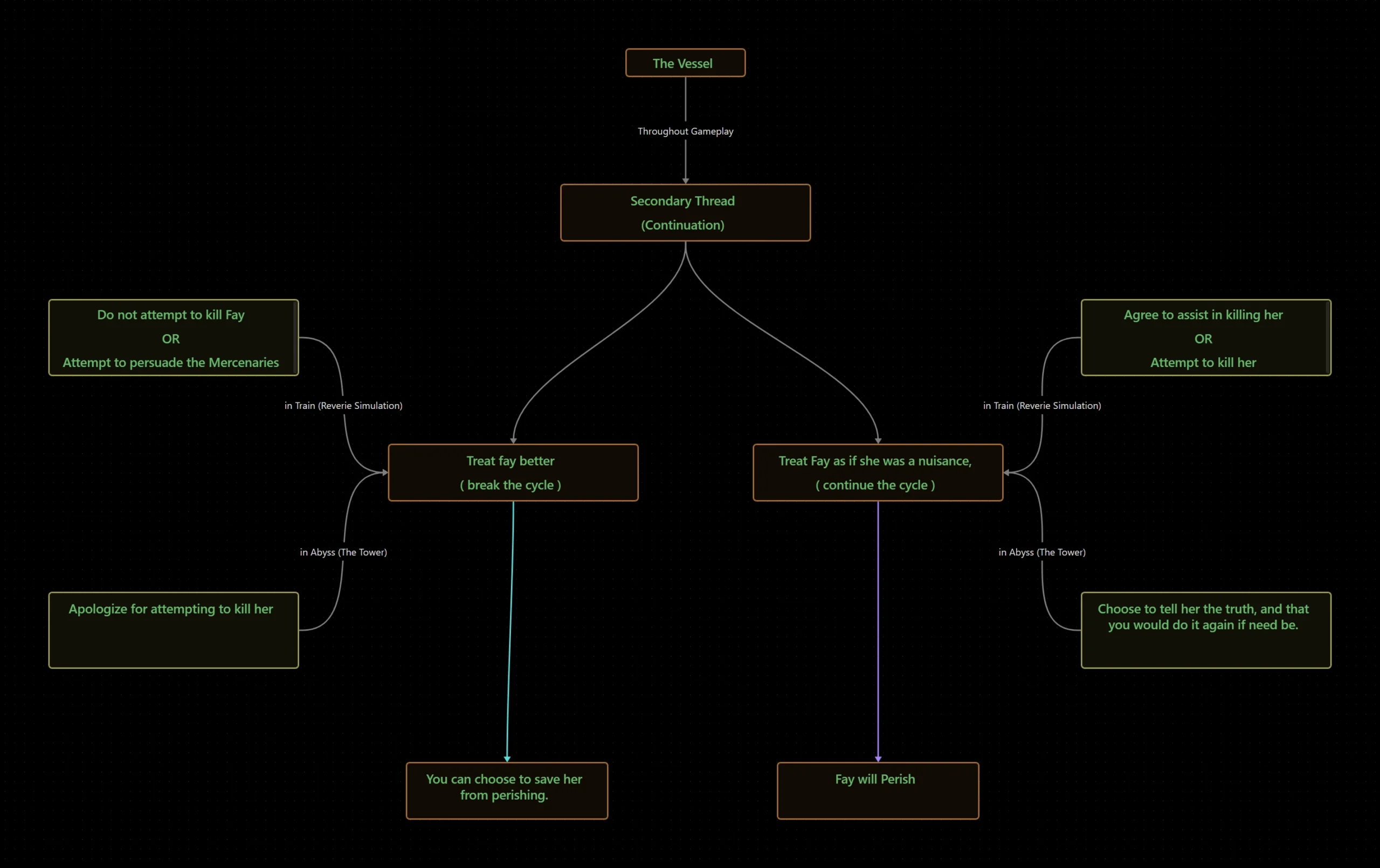
Mechanically,
Throughout the game, the
player is given repeated
chances to interact with
Fay in ways that
demonstrate care or
neglect.
These interactions
directly determine
her fate.
If the player
consistently treats her
with kindness and
guidance, they unlock
the option to save her
near the end of the
game. If not, her death
becomes unavoidable.
Secondary Thread
(Propagate)
Thematically,
Propagation represents
the way trauma spreads
when left
untended, through
learned behavior, and
unconscious influence.
People often
replicate what was
done to them,
especially when
under pressure, and
pass it on to others
without meaning
to.
07. Refactoring
Twine Prototype (Full)
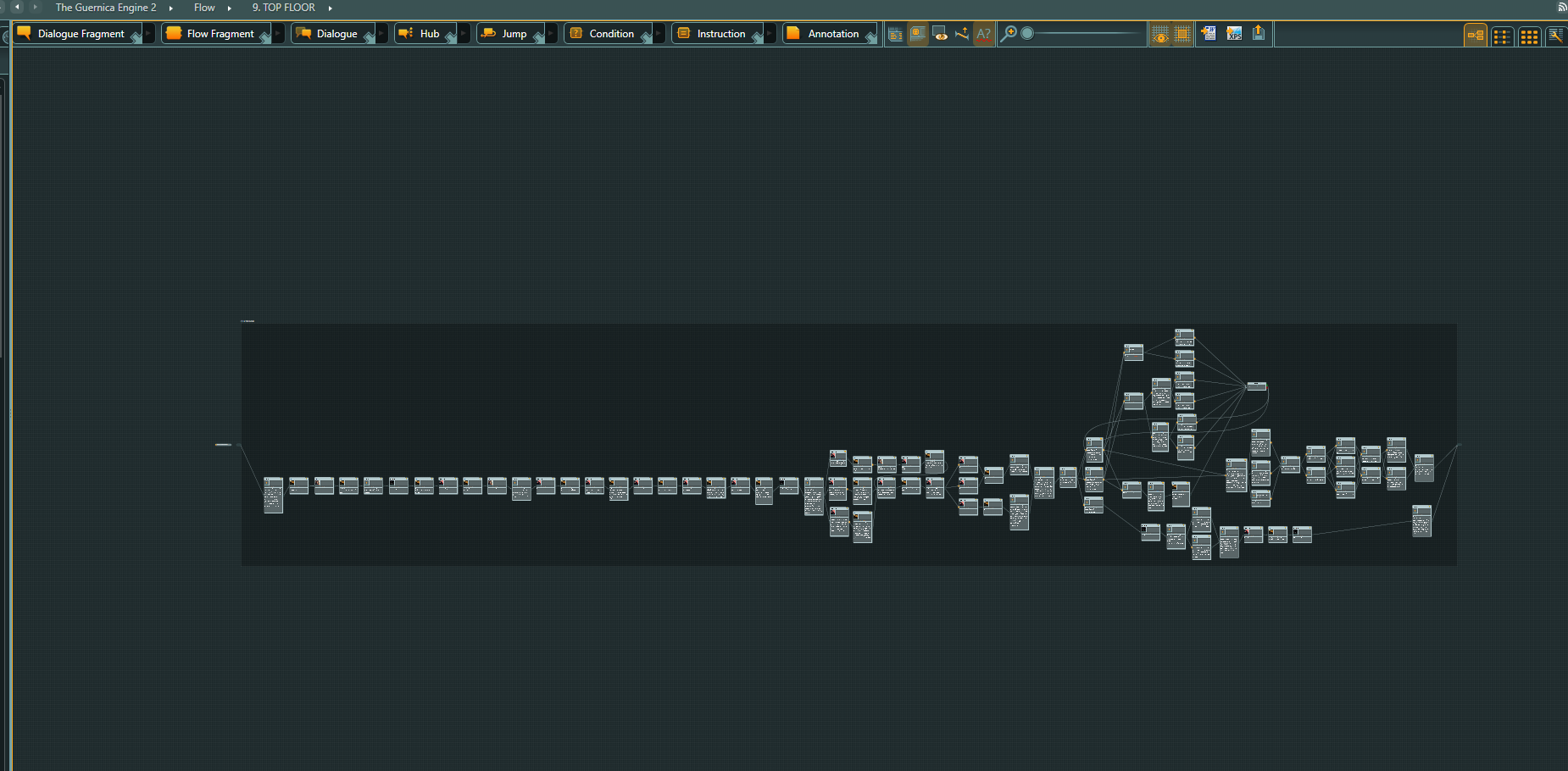
Articy Draft Protoype (First Chapter)
Along with the technical changes, the UI
layout was also updated to be more compact, so
I adjusted the writing to fit the smaller
design and word limits, ensuring everything
was still clear and effective in the new
format.
As the project progressed, the requirements
shifted, and we needed to move to a new
platform, which meant using
Articy Draft
for the prototype. I wasn’t familiar
with it at first, but I quickly got up to
speed with its features and used it to create
what was needed for the new platform.
After finishing all the prep work, I executed
the story and created multiple drafts of the
game prototype using, twine and articy
draft. After multiple rounds of editing, I
delivered the prototypes to the client for
further development.
Twine Prototype - Branching Paths
This is a quick demo of the prototype. You can
play through it and see a small introduction to
the story and the world.
If you would like to see more of it, please feel
free to reach out.